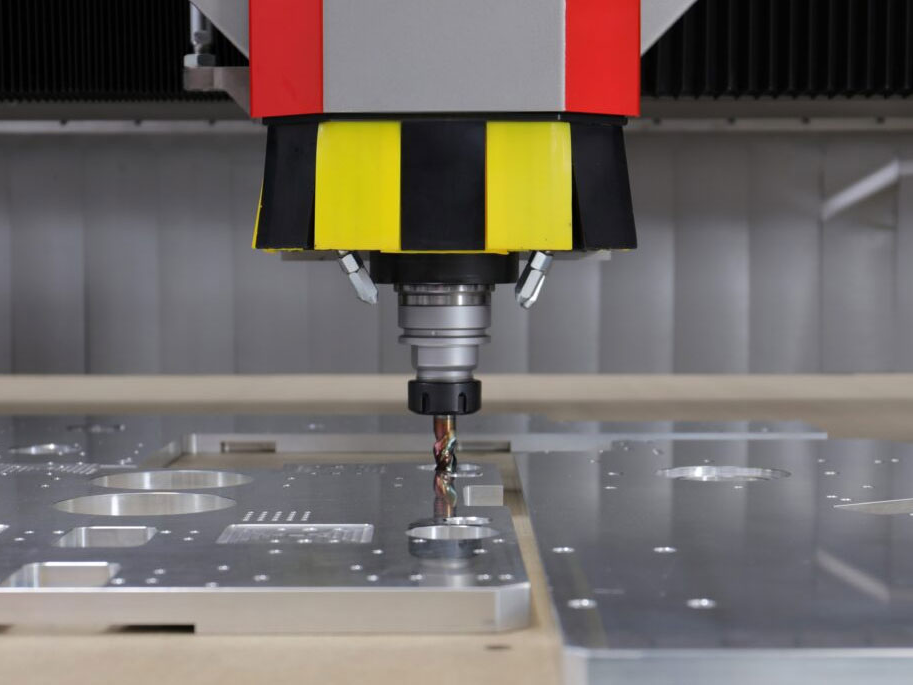
Machining complex pieces with a single machine is now possible. 5-axis CNC milling machines are revolutionizing precision machining. If you want to elevate your production and face previously unthinkable geometric challenges, you need to know these machines.
90% of workshops that process complex parts do not fully exploit the potential of their machines. They’re just busier repositioning the pieces. If you really want to produce more and better, you have to stop doing multi-step processes. Here’s how a 5-axis CNC milling machine can transform your workshop. If you are thinking about buying a CNC milling machine, keep reading.
What Makes a “5-Axis” CNC So Special?
Have you ever wondered how they create those super complex shapes, those curved and detailed surfaces you see in aerospace components or medical prosthetics? Well, it is often thanks to a 5-axis CNC milling machine. Unlike 3-axis machines (which only move up and down, forward/backward, and right/left), 5-axis machines add two rotary axes. These axes allow the milling head or workpiece to tilt and rotate, letting the tool reach virtually every point on the workpiece from different angles, all in a single setup.
And here’s the best part: this means you can mill an entire piece without having to dismantle and reposition it manually. Imagine you need to machine a component with deep cavities, undercuts, or complex curved surfaces. With a 3-axis machine, you would have to do more setup, use special tools, and probably get less precise results. With a 5-axis machine, all this becomes much simpler and more efficient. It’s like having a surgeon who can move their scalpel from every possible angle, instead of having to constantly pause to reposition the patient.
The Key Benefits of 5-Axis Working
What are the concrete advantages of having a 5-axis CNC milling machine? First of all, the reduction in processing times. Fewer setups mean less downtime. Instead of having to reposition the part multiple times, you can complete most, if not all, machining in one setup. This directly translates into greater productivity. And time saved in setup can be reinvested in actual production.
Then there’s the improved accuracy. Every time you move a piece, there’s a risk of introducing small alignment errors. By working in a single setup, you eliminate these errors, resulting in tighter tolerances and greater consistency between parts. And let’s not forget the ability to create complex geometries. Curved surfaces, undercuts, fine details: all this becomes achievable with a 5-axis machine. Think of a mold maker for the automotive industry. Complex mold shapes require tool tilt that only a 5-axis machine can offer.
When Do You Really Need a 5-Axis Milling Machine?
Okay, a 5-axis machine is great, but do you really need it? Cost is a factor, but wait, there’s more. If you machine parts with simple geometries, such as cubes or flat plates, a 3-axis machine may be more than sufficient. But if you find yourself having to mill components with complex curved surfaces, deep cavities, or undercuts, or if you need to machine a part from multiple angles without repositioning, then a 5-axis machine becomes almost indispensable.
Consider those who make turbine blades, components for medical prosthetics, intricate molds, or parts for the aerospace industry. These applications require three-dimensional precision that only a 5-axis machine can efficiently guarantee. If your goal is to produce components with high added value, where geometric complexity and precision are fundamental, then investing in a 5-axis CNC milling machine is a strategic choice. However, if you primarily produce simple parts in large volumes, you may get better results with more specialized and potentially less expensive 3- or 4-axis machines.
The Purchasing Process: How to Choose the Right Machine
If you have decided that a 5-axis CNC milling machine is the right choice for you, how do you choose the perfect one? First, consider the type of work you will do most often. There are “simultaneous” 5-axis machines (where all 5 axes move at the same time to create complex shapes) and 3+2-axis machines (where the rotary axes are used to position the workpiece at a fixed angle, and then machining occurs as on a 3-axis machine). The former are more versatile but more expensive and require more advanced CAM software.
Then, think about the dimensions of your piece and the work area needed. Make sure the machine can comfortably accommodate your components. Spindle horsepower is another important factor, especially if you’re working with hard materials. And don’t forget the quality of construction and accuracy of the axes. If you are considering buying a CNC milling machine, it is essential to evaluate these aspects. Ask about the included or compatible CAM software, because to take full advantage of a 5-axis machine, you need software capable of programming simultaneous movements.
CAM Software and Programming: The 5 Axis Challenge
Here’s the kicker: programming a 5-axis machine is more complex than programming a 3-axis machine. It requires advanced CAM (Computer-Aided Manufacturing) software capable of managing simultaneous axis movements and simulating the process to avoid collisions. The software must be able to calculate optimized tool paths for complex geometries, taking into account tool inclination, tool length, and possible impacts with the workpiece or the machine itself. Graphical simulation is essential: it allows you to “see” how the machine will machine the piece before you even start it. And then there is training. Learning to use advanced 5-axis CAM software takes time and dedication, but many machine manufacturers offer specific training courses, which are a valuable investment if you want to master this technology.
The Impact on Your Workshop: Efficiency and New Opportunities
Having a 5-axis CNC milling machine in your workshop can really change the game. It’s not just about being able to do more complex pieces. It’s about becoming more efficient. Less setup, fewer repositioning errors, and reduced machining times for complex pieces means greater productivity and, potentially, higher profit margins. Consider that a 5-axis machine, despite having a higher initial cost, can open the doors to new markets and customers who require high precision and complexity machining.
Think of a workshop that previously had to subcontract complex processes. By purchasing a 5-axis machine, you can internalize these processes, maintaining control over quality and delivery times, and increasing your added value. Do you feel ready to take this leap? It’s an investment, sure, but it’s an investment in capacity, efficiency, and the future.
Maintenance and Longevity of a 5-Axis Machine
5-axis machines, with their rotary axes and more complex control systems, require careful maintenance. It is essential to scrupulously follow the preventive maintenance plan indicated by the manufacturer. This includes regular cleaning, lubrication of axes and components, and periodic checks of measurement systems and sensors.
Rotary axis drive systems, in particular, require attention. Ensure that the play is minimal and that the movements are smooth. Periodic calibration of the axes is crucial to maintaining accuracy. If you are considering buying a CNC milling machine, also find out about the technical support offered by the manufacturer and the availability of spare parts. Good maintenance not only guarantees the longevity of the machine but also the consistency of its precision over time, which is fundamental for complex processes.
The Future is Multi-axis
Today, Marco works in a bright and modern workshop. On the floor, a 5-axis CNC milling machine shines under the lights. He just completed a batch of complex aerospace components, all in one setup. He is no longer limited by the geometry of the parts or the complexity of the setups. He embraced technology that gave him control. And you? Are you ready to master complexity and take your production to the next level?


